Trading costs erode profitability faster than most retail traders realize. While beginners often focus on finding the best entry signals or perfecting their technical analysis, the fees you pay to your broker can quietly consume 15-30% of your trading capital over time. Brokers generate revenue through multiple channels—spreads, commissions, swap fees, and less visible costs like slippage—and the differences between fee structures can mean thousands of dollars annually. This article breaks down each cost component with real numbers, explains how market maker and ECN pricing models compare, and shows you how to calculate your true trading expenses based on your actual position sizes and holding periods. Understanding these mechanics isn’t optional; it’s the foundation of choosing the right broker and protecting your long-term performance.
How Forex Brokers Generate Revenue

Forex brokers operate businesses that require infrastructure, technology, regulatory compliance, and staff—all of which cost money. Understanding how these firms generate revenue directly impacts your bottom line as a trader, since every dollar your broker earns represents a cost to you. Research indicates that trading costs can account for 15-30% of retail trader losses, making broker fee structures one of the most consequential decisions you’ll face before placing your first trade.
Brokers rely on three primary revenue streams: spreads, commissions, and swap fees. The emphasis placed on each varies dramatically depending on the broker’s business model, creating meaningful differences in what you’ll pay based on your trading style and volume.
Spreads represent the difference between the bid price (what you receive when selling) and the ask price (what you pay when buying). This gap is measured in pips—the smallest price increment in forex trading. When you see EUR/USD quoted at 1.0850/1.0852, that 2-pip spread means you’re effectively paying the broker $20 per standard lot just to enter the position. Major currency pairs like EUR/USD typically display spreads ranging from 0.1 to 3 pips depending on broker type and market conditions. Market maker brokers often advertise fixed spreads that remain constant regardless of volatility, while ECN (Electronic Communication Network) brokers offer variable spreads that tighten during liquid market periods and widen during news releases or off-peak hours.
Commissions function as explicit per-trade fees, typically calculated per lot traded. Commission-based brokers charge between $2 and $7 per round turn (opening and closing) for standard accounts, with institutional traders often negotiating lower rates based on volume. A broker charging $5 per lot means you’ll pay $10 total for entering and exiting a single standard lot position—$5 on entry and $5 on exit. This transparent pricing model appeals to traders who prefer knowing exactly what they’re paying rather than having costs embedded in wider spreads.
Swap fees (also called rollover fees) apply when you hold positions overnight past 5pm Eastern Time. These charges or credits reflect the interest rate differential between the two currencies in your pair. If you’re long AUD/JPY, you might receive a credit because the Australian dollar typically carries higher interest rates than the Japanese yen. Conversely, going short the same pair would generate a debit. Swap rates aren’t trivial—holding a position for weeks can accumulate fees exceeding the spread cost.
Different broker types emphasize different revenue models. Market makers generate most income through spreads while offering commission-free trading. ECN/STP (Straight Through Processing) brokers combine tight spreads with explicit commissions, passing your orders directly to liquidity providers rather than taking the opposite side of your trades. This structural difference explains why an ECN broker might advertise spreads as low as 0.0 pips on EUR/USD while charging $7 per lot in commission, whereas a market maker offers 1.5-pip spreads with zero commission. The total cost requires calculation: the ECN broker’s 0.2-pip average spread plus $7 commission ($3.50 per side) versus the market maker’s fixed 1.5 pips translates to roughly equivalent costs on a standard lot, but the equation shifts dramatically with different position sizes and holding periods.
Spreads: The Primary Cost of Every Trade

Every time you enter a Forex trade, you’re starting at a small loss. The spread—the difference between the bid price (what you can sell for) and the ask price (what you must pay to buy)—represents your immediate cost before the market even moves. If EUR/USD shows a bid of 1.0850 and an ask of 1.0852, that 2-pip spread means you need the market to move 2 pips in your favor just to break even.
Spreads are measured in pips, the smallest price increment most currency pairs move. For major pairs like EUR/USD, GBP/USD, and USD/JPY, retail brokers typically offer spreads ranging from 0.1 to 3 pips. The variation is significant: a 0.1-pip spread costs you $1 per standard lot, while a 3-pip spread costs $30 for the same position size. Over hundreds of trades, this difference compounds into thousands of dollars.
The spread you pay consists of two components: the interbank spread (what banks charge each other) and the broker’s markup. Major pairs trade with interbank spreads as tight as 0.0 to 0.1 pips during peak liquidity. Your broker adds their markup on top—anywhere from 0.1 to 2 pips depending on their business model and account type. An ECN broker might charge 0.2 pips total plus a separate commission, while a market maker might offer 1.5 pips with no commission.
Fixed vs. Variable Spreads
Brokers offer two spread structures, each with distinct advantages and drawbacks. Fixed spreads remain constant regardless of market conditions—EUR/USD might stay at 2 pips whether markets are calm or volatile. Market maker brokers typically provide fixed spreads because they’re taking the opposite side of your trade and can control pricing. The predictability helps with cost calculation, but fixed spreads are usually wider than variable spreads during normal market hours.
Variable spreads fluctuate based on market liquidity and volatility. During the London-New York overlap (8am-12pm EST), when liquidity peaks, EUR/USD spreads might tighten to 0.2 pips. During the Asian session or minutes before major news releases, those same spreads can balloon to 5 or even 10 pips. ECN and STP brokers offer variable spreads because they’re passing through actual market pricing from liquidity providers. While you benefit from tighter spreads during optimal conditions, you accept the risk of wider spreads when liquidity dries up.
When Spreads Widen
Spread widening catches many traders off guard, turning seemingly profitable strategies into losing propositions. Three primary scenarios trigger dramatic spread expansion:
Major economic announcements create the most extreme widening. In the 5 to 10 minutes surrounding Non-Farm Payrolls, Federal Reserve decisions, or central bank rate announcements, spreads can expand 10 to 50 times their normal size. A pair that normally trades at 0.5 pips might jump to 25 pips or more. Liquidity providers pull their orders because price direction becomes unpredictable, leaving brokers to widen spreads to manage their risk exposure.
Low liquidity periods include weekend gaps, major holidays, and the hours between the New York close (5pm EST) and Tokyo open (7pm EST). With fewer market participants, the gap between available buy and sell orders widens naturally. Sunday evening openings are particularly notorious—spreads might be 3 to 5 times wider than normal Monday morning levels.
Flash crashes and extreme volatility force brokers to protect themselves from rapid price swings. During the Swiss National Bank’s 2015 franc de-pegging or the 2016 Brexit vote, some brokers widened EUR/CHF spreads to 300+ pips as normal market functioning broke down. While such events are rare, they demonstrate how spreads can become a trader’s largest cost during crisis conditions.
Market conditions also affect exotic and minor pairs more severely than majors. While EUR/USD might widen from 0.5 to 5 pips during news, a pair like USD/TRY or EUR/SEK could expand from 15 pips to 150 pips. The thinner liquidity in these markets amplifies spread volatility, making them expensive to trade during anything but the calmest conditions.
Commission-Based Pricing Models

ECN (Electronic Communication Network) and STP (Straight Through Processing) brokers typically separate their revenue model into two distinct components: tight spreads and per-trade commissions. Rather than widening the spread to capture profit, these brokers charge a transparent fee for each transaction while passing through near-raw market spreads that may start as low as 0.0 pips on major currency pairs like EUR/USD.
Commission structures operate on a per-lot basis, with standard retail accounts typically paying between $2 and $7 per round turn lot. A “lot” in forex represents 100,000 units of the base currency, so a trader opening a 1.0 lot position on EUR/USD is trading €100,000. The commission applies regardless of whether the trade is profitable—it’s a fixed cost of market access, similar to paying a toll to use a premium highway.
Calculating Commission Costs
Understanding the actual dollar amount you’ll pay requires multiplying the commission rate by your position size. Here’s how the calculation works in practice:
- Identify your position size in lots: If you’re trading 0.5 lots (50,000 units), and your broker charges $6 per round turn lot, your commission is $3 total for both opening and closing the trade.
- Determine if pricing is round turn or per-side: A $6 round turn commission means $6 total for the complete trade cycle. A $3 per-side commission means $3 to open and $3 to close—also $6 total, but quoted differently.
- Multiply commission by lot size: Trading 2.0 lots with a $5 round turn commission costs $10 in fees. Trading 0.1 lots (a micro lot) costs just $0.50.
For comparison, consider a trader opening a 1.0 lot EUR/USD position with a broker charging $5 round turn commission versus a zero-commission broker offering a 1.5 pip spread. The commission-based trader pays $5 in fees. The spread-based trader pays approximately $15 (1.5 pips × $10 per pip on a standard lot). In this scenario, the commission structure saves $10 per trade.
Round Turn vs. Per-Side Pricing
Brokers quote commissions using two standard formats, and understanding the difference prevents confusion when comparing offers.
Round turn pricing bundles the entire trade cost into a single number. When a broker advertises “$6 per lot,” they mean $6 for the complete cycle of opening and closing a position. You’ll see half the commission ($3) deducted when you open the trade and the remaining half ($3) when you close it. This format simplifies comparison shopping since the advertised rate represents your total cost.
Per-side pricing splits the commission explicitly. A broker charging “$3 per side” deducts $3 when you enter and another $3 when you exit—identical to a $6 round turn, just presented differently. Some traders prefer this transparency because they can see exactly what each action costs, though it requires mental math to compare against round turn quotes.
High-volume traders and institutional accounts often negotiate preferential commission rates, sometimes dropping below $2 per round turn lot. A trader executing 500 lots monthly might qualify for $3 commissions instead of the standard $6—a $1,500 monthly savings that compounds significantly over time. These volume-based discounts reward active participants and can substantially impact the profitability of high-frequency or scalping strategies where transaction costs represent a larger portion of potential gains.
Market Maker vs. ECN Broker Cost Structures
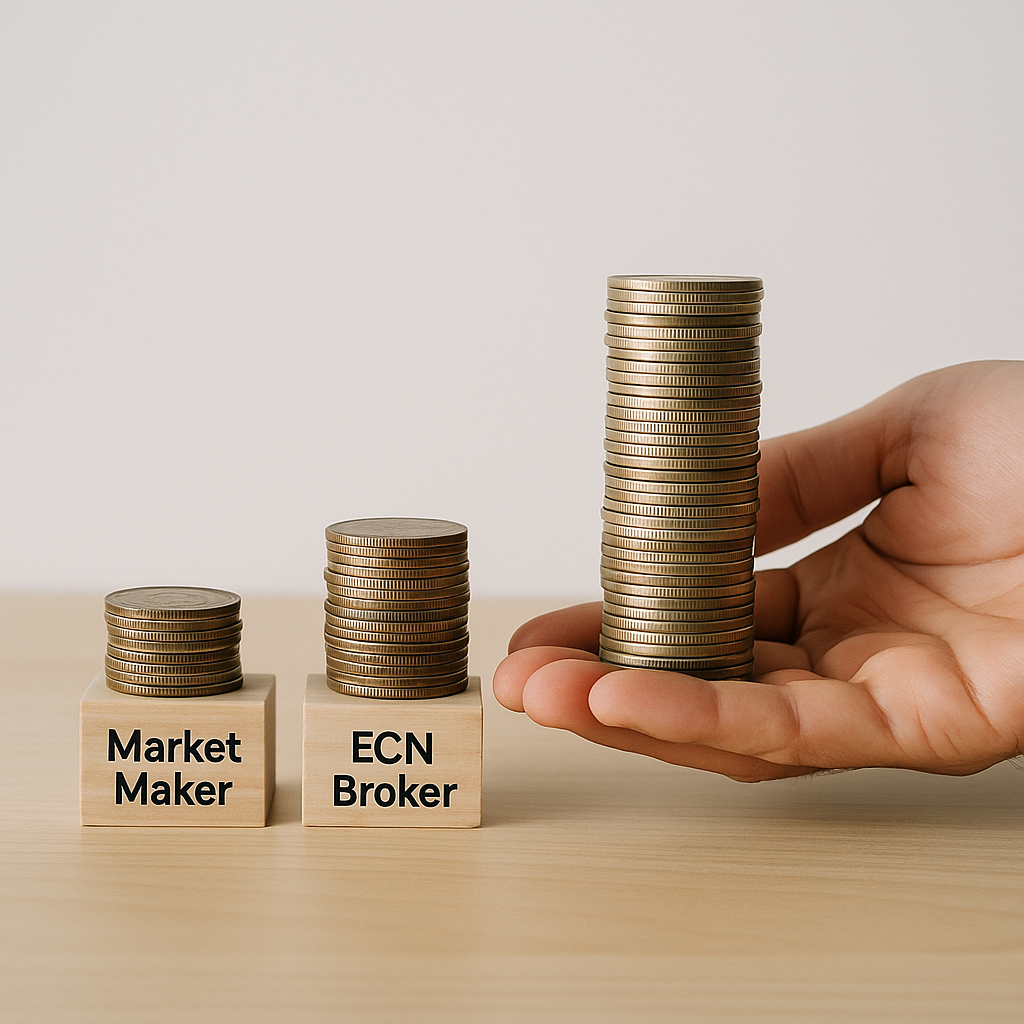
The choice between a market maker and an ECN broker fundamentally changes how you pay for each trade. A market maker might advertise “zero commission trading” with a 1.5 pip spread on EUR/USD, while an ECN broker charges a 0.2 pip spread plus a $6 per lot commission. At first glance, the market maker appears cheaper—but the math tells a different story depending on your trading volume and style.
Market Maker Advantages and Drawbacks
Market makers create their own internal market by taking the opposite side of client trades. When you buy EUR/USD, the market maker sells it to you from their inventory. This model allows them to offer fixed spreads that remain constant regardless of market conditions. During the London open, when interbank spreads might tighten to 0.1 pips, your market maker still charges 1.5 pips. During major news events, when interbank spreads widen to 5 pips, you still pay just 1.5 pips.
This predictability benefits traders who need to calculate costs precisely before entering positions. A swing trader planning to hold EUR/USD for several days knows exactly what the entry and exit will cost. Market makers also typically don’t charge separate commissions, simplifying the fee structure for beginners who might find multiple cost components confusing.
The structural conflict of interest, however, cannot be ignored. When you profit, the market maker loses on the opposite position—unless they successfully hedge your trade in the interbank market. Many reputable market makers do hedge aggressively, but the incentive to engage in practices like stop-hunting or requotes during volatile periods exists within the business model itself. Additionally, those fixed spreads often contain a premium that exceeds what you’d pay with an ECN broker during normal market hours.
ECN/STP Cost Benefits
ECN (Electronic Communication Network) and STP (Straight Through Processing) brokers route your orders directly to liquidity providers—major banks, hedge funds, and other institutional traders. Instead of taking the opposite side of your trade, they aggregate prices from multiple sources and pass the best bid and ask prices to you. This direct market access means spreads fluctuate with actual market conditions.
During peak liquidity hours, typically when London and New York sessions overlap, spreads on EUR/USD can compress to 0.0-0.2 pips. The broker charges a separate commission, usually $3-7 per standard lot for a round turn (opening and closing the trade). For a typical retail account, a $6 commission combined with a 0.2 pip spread equals a total cost of approximately 0.8 pips—nearly half the 1.5 pip spread a market maker charges.
| Broker Type | Typical EUR/USD Spread | Commission per Lot | Total Cost (Standard Lot) |
|---|---|---|---|
| Market Maker | 1.5 pips (fixed) | $0 | $150 |
| ECN/STP | 0.2 pips (variable) | $6 | $26 + $6 = $86 |
| ECN/STP (Peak Hours) | 0.0 pips (variable) | $6 | $6 |
The advantage becomes more pronounced for high-frequency traders. A scalper executing 50 trades per week saves $3,200 monthly by paying $86 instead of $150 per standard lot. The variable spread does introduce unpredictability during news releases or thin market conditions, when spreads can temporarily spike to 3-5 pips even with ECN brokers.
Total cost comparison ultimately depends on which currency pairs you trade and when. Exotic pairs like USD/TRY often show smaller percentage differences between broker types because base spreads are already wide. Major pairs during peak hours favor ECN pricing, while traders active during Asian session quiet periods might find market maker fixed spreads more competitive when ECN spreads widen due to lower liquidity.
Swap Rates and Overnight Financing Costs

When you hold a forex position past 5pm Eastern Standard Time, your broker applies a swap rate—also called a rollover fee—to your account. This charge reflects the interest rate differential between the two currencies you’re trading. Unlike spreads and commissions that apply when you open a trade, swap fees accumulate for each night you maintain an open position.
The mechanism works because forex trades involve borrowing one currency to buy another. If you’re long EUR/USD, you’re effectively borrowing US dollars to purchase euros. The swap rate represents the cost of borrowing the quote currency minus the interest earned on holding the base currency. Depending on the interest rate differential and your position direction, this can either cost you money or credit your account.
For example, if you’re long AUD/JPY and Australian interest rates are 4.35% while Japanese rates sit at -0.10%, you’ll typically receive a positive swap. The interest earned on holding Australian dollars exceeds the cost of borrowing yen. Conversely, if you’re short AUD/JPY, you’ll pay a negative swap because you’re now borrowing the higher-yielding currency.
How Swap Rates Are Calculated
Brokers calculate swap rates using the interbank overnight lending rates for each currency, adding their own markup. The formula accounts for the position size, the interest rate differential, and the number of days the position remains open. Most brokers apply a triple swap on Wednesdays to account for weekend holding costs, since forex markets close Saturday and Sunday but interest still accrues.
A standard lot position (100,000 units) on EUR/USD with a 1% interest rate differential might generate a swap of approximately $2.74 per night. At 5 standard lots, that becomes $13.70 daily—over $4,900 annually if you maintain the position for a full year. These costs can significantly erode profits on longer-term positions, particularly for carry trades where swap rates form part of the trading strategy itself.
Swap-Free Account Alternatives
Islamic or swap-free accounts eliminate overnight financing charges to comply with Sharia law, which prohibits earning or paying interest. Brokers offering these accounts must still cover their funding costs, so they typically implement alternative fee structures. Some brokers charge wider spreads on swap-free accounts, while others apply fixed administration fees for positions held beyond a certain number of days—commonly three to seven days.
A broker might offer standard EUR/USD spreads of 0.8 pips but increase them to 1.2 pips for swap-free accounts. Others maintain identical spreads but charge $5-$25 per lot for positions held longer than their specified threshold. These alternative structures mean swap-free accounts aren’t necessarily cheaper; traders need to calculate whether the swap-free benefit outweighs the additional costs based on their typical holding periods.
Hidden Costs: Slippage, Requotes and Withdrawal Fees

Beyond the explicit costs of spreads, commissions, and swaps, several less visible expenses can significantly impact your trading profitability. These hidden costs often catch new traders by surprise and can exceed the advertised trading fees, particularly during volatile market conditions or with certain broker practices.
Slippage
Slippage occurs when your order executes at a different price than you requested. You click to buy EUR/USD at 1.0850, but your fill comes through at 1.0852—a 2-pip difference that costs you $20 on a standard lot. This happens because forex markets move continuously, and the price available when you submit your order may have changed by the time the broker processes it.
Market orders are particularly vulnerable to slippage during high-volatility periods. Major news releases like Non-Farm Payrolls can move prices 50-100 pips in seconds. A trader attempting to enter during the announcement might experience 5-10 pips of slippage routinely. Over time, consistent slippage of just 1-2 pips per trade adds up: a trader executing 100 trades monthly with 1.5 pips average slippage pays an additional $1,500 in hidden costs on standard lots.
ECN brokers typically display lower slippage than market makers during normal conditions because they’re accessing deeper liquidity pools. However, during extreme volatility, even ECN execution can slip significantly. Using limit orders instead of market orders provides price certainty—your order only fills at your specified price or better—though you risk missing the trade entirely if price moves away quickly.
Requotes and Order Rejections
Some brokers, particularly market makers, issue requotes when market conditions change between order submission and execution. You attempt to buy at 1.0850, but instead of executing, the platform displays a message: “Price has changed to 1.0853. Accept new price?” This delay costs you the original entry and forces a decision under pressure.
Frequent requotes indicate either poor execution infrastructure or deliberate broker practices to avoid filling orders at favorable client prices. Requotes cluster around major news events and during rapid price movements—exactly when traders most need reliable execution. A broker that requotes 10-15% of your orders during volatile periods effectively increases your trading costs while degrading your strategy’s performance.
Order rejections function similarly but simply refuse to execute your trade at any price. The platform returns an error message, forcing you to resubmit. By the time you do, the opportunity may have vanished. Reputable brokers maintain execution rates above 95-98% even during busy periods, while problematic brokers might reject 20-30% of orders during news events.
Non-Trading Fees
Deposit and withdrawal fees vary dramatically between brokers and payment methods. Wire transfers commonly cost $15-$40 per withdrawal, while credit card withdrawals might incur 2-3% processing fees. A trader withdrawing $5,000 via wire pays $25, effectively adding 0.5% to their trading costs. Frequent withdrawals compound this expense quickly.
Inactivity fees penalize dormant accounts, typically charging $10-$50 monthly after 90-180 days without trading activity. A trader taking a three-month break might return to find $150 deducted from their account. Some brokers also charge monthly platform fees, data fees, or account maintenance fees ranging from $10-$100, particularly for premium platforms or advanced charting tools.
Currency conversion fees apply when you deposit or withdraw in a currency different from your account base currency. A trader with a USD account depositing €5,000 might pay 0.5-2% in conversion markup above the interbank rate—an additional $25-$100 cost that doesn’t appear in advertised fee schedules. Reading the complete fee schedule before opening an account prevents these surprises from eroding your capital.
Calculating Your Total Trading Costs

Understanding individual fee components means little without calculating what you’ll actually pay based on your trading behavior. A broker advertising 0.1-pip spreads might cost you more than one offering 1.5-pip spreads if your trading style, position sizes, and holding periods don’t align with their fee structure.
Cost Per Trade Formula
Your total cost per trade combines all fee components:
Total Cost = (Spread in pips × Pip value × Lot size) + Commission + (Swap rate × Days held)
For a practical example, consider a trader opening a 1.0 lot EUR/USD position with these broker terms:
- Spread: 0.8 pips
- Commission: $6 round turn
- Swap rate: -$2.50 per night
- Position held: 3 days
The calculation breaks down as follows:
- Spread cost: 0.8 pips × $10 per pip × 1 lot = $8
- Commission: $6
- Swap cost: -$2.50 × 3 nights = -$7.50
- Total cost: $8 + $6 + $7.50 = $21.50
That same trade with a market maker offering 1.5-pip spreads, no commission, and -$3.00 nightly swap would cost:
- Spread cost: 1.5 pips × $10 × 1 lot = $15
- Commission: $0
- Swap cost: -$3.00 × 3 nights = -$9.00
- Total cost: $15 + $0 + $9.00 = $24.00
The ECN broker saves $2.50 on this specific trade, but the advantage would shrink or reverse if you were scalping with a 30-minute average hold time where swap fees don’t apply.
Monthly and Annual Cost Projections
Calculating costs across your expected trading volume reveals the true financial impact. A day trader executing 10 round-turn trades daily, 20 days per month, generates 200 monthly trades. At $21.50 per trade, monthly costs reach $4,300. Annually, that’s $51,600 in trading expenses before considering slippage or other hidden costs.
Reducing per-trade costs by just $3 through better broker selection saves $600 monthly or $7,200 annually. For a trader with a $50,000 account, that 14.4% annual cost reduction can mean the difference between profitable and unprofitable performance. Small cost differences compound dramatically at scale.
Position traders holding 5-10 positions for weeks at a time face different economics. A trader maintaining an average of 7 open positions with $3 daily swap costs per position pays $63 daily or $1,890 monthly in rollover fees alone—potentially exceeding spread and commission costs combined. For this trader, swap rates become the dominant cost factor, making swap-free accounts or brokers with competitive rollover rates essential.
Comparing Broker Offers
When evaluating competing broker offers, build a comparison spreadsheet using your actual trading parameters:
- Average position size: Do you typically trade 0.1, 0.5, or 2.0 lots?
- Average holding period: Are you in and out within minutes, hours, or days?
- Monthly trade volume: How many round turns do you execute?
- Primary currency pairs: Do you trade majors, minors, or exotics?
- Trading hours: Are you active during peak liquidity or Asian session?
Apply each broker’s spread, commission, and swap rates to your parameters. A broker might advertise the tightest spreads but charge higher commissions that make them expensive for small position sizes. Another might offer poor spreads on exotics while being highly competitive on majors. The “best” broker depends entirely on your individual trading profile, not on marketing claims or generic reviews.
Frequently Asked Questions

What’s the difference between spread and commission?
The spread is the difference between the buy and sell price, measured in pips, and represents an implicit cost built into the price you pay. Commission is an explicit fee charged per lot traded, typically between $2-$7 per round turn. Some brokers charge only spreads, others charge both tight spreads plus commissions. Neither model is inherently better—total cost depends on the specific rates and your trading volume.
Are ECN brokers always cheaper than market makers?
Not necessarily. ECN brokers typically offer tighter spreads during peak liquidity hours but charge commissions and may show wider spreads during quiet periods. Market makers offer fixed spreads that can be more competitive during low liquidity or high volatility. For scalpers trading major pairs during London-New York overlap, ECN pricing usually wins. For swing traders or those trading during Asian hours, market maker fixed spreads might cost less overall.
How much do swap fees typically cost?
Swap rates vary by currency pair and position direction, typically ranging from -$0.50 to -$5.00 per night per standard lot for retail accounts. Pairs with large interest rate differentials like AUD/JPY or NZD/JPY show larger swaps. A position held for one month might accumulate $75-$150 in swap costs per lot, making rollover fees a significant expense for position traders. Always check your broker’s specific swap rates for the pairs you trade.
Can I avoid swap fees entirely?
Islamic or swap-free accounts eliminate overnight financing charges but typically compensate through wider spreads or administration fees for positions held beyond 3-7 days. These accounts aren’t necessarily cheaper—you’re trading swap fees for alternative costs. Day traders who close all positions before 5pm EST avoid swaps naturally without needing specialized accounts.
What’s an acceptable amount of slippage?
During normal market conditions with limit orders, you should experience minimal to zero slippage. Market orders during average volatility might slip 0.5-1 pip on major pairs. During major news events, 3-5 pips of slippage is common even with quality brokers. If you’re consistently seeing 2+ pips of slippage during calm markets, your broker’s execution quality is poor and you should consider switching.
Do withdrawal fees really matter?
For traders making frequent withdrawals, absolutely. A $25 wire fee on a $2,000 withdrawal is 1.25% of your capital. If you withdraw monthly, that’s 15% annually in withdrawal fees alone. Using free withdrawal methods like e-wallets or limiting withdrawal frequency to quarterly reduces this expense. Some brokers offer one free withdrawal monthly, making them preferable for traders who regularly move funds.
How do I know if my broker’s costs are competitive?
Compare total costs, not individual components. Calculate your actual expense per trade using your typical position size, holding period, and trading frequency. Check spreads during the hours you actually trade—advertised spreads often reflect optimal conditions you may not access. Read the complete fee schedule for non-trading costs. A broker might have great spreads but charge $40 wire fees and $15 monthly inactivity fees that make them expensive overall.
Choosing a Broker Based on Your Trading Style

Your trading approach determines which fee structure minimizes costs. A scalper executing 50 trades daily faces entirely different economics than a swing trader holding 5 positions for weeks. Matching broker pricing to your specific behavior can save thousands annually.
Day Traders and Scalpers
High-frequency traders prioritize tight spreads and fast execution over swap rates, since positions close before rollover. ECN brokers with spreads starting at 0.0-0.3 pips plus $3-5 commissions typically offer the lowest per-trade costs. On 200 monthly trades, the difference between 0.2-pip and 1.5-pip spreads equals $2,600 annually per lot traded—enough to determine whether your strategy remains profitable.
Execution speed and slippage matter more for scalpers than for any other trading style. A 1-pip slippage on a strategy targeting 3-pip gains destroys 33% of your profit potential. Look for brokers advertising execution speeds under 50 milliseconds and maintaining 98%+ fill rates during normal conditions. Server location matters—if you’re in New York trading during U.S. hours, a broker with New York-based servers reduces latency compared to one routing through London.
Swing Traders
Traders holding positions for days to weeks must balance spread costs against swap fees. A broker offering 1.2-pip spreads with -$1.50 nightly swaps might cost less than one with 0.5-pip spreads and -$4.00 swaps if you hold positions for 5+ days. Calculate total cost including expected holding period rather than focusing solely on entry costs.
Swap-free accounts become attractive for swing traders in certain pairs. If you’re holding positions for 10-14 days and paying $3 nightly in negative rollover, that’s $30-$42 in swap costs per trade. A swap-free account charging a 0.3-pip wider spread costs only $3 extra per trade—a significant saving. However, verify the swap-free terms; some brokers charge administration fees after 7 days that eliminate the benefit.
Position Traders
Long-term traders holding positions for weeks or months find swap rates dominating their cost structure. A position held for 60 days at -$2.50 nightly accumulates $150 in rollover fees—potentially exceeding the spread cost by 10-15 times. For these traders, finding brokers with competitive or positive swap rates matters more than shaving 0.2 pips off the spread.
Consider carry trade opportunities where positive swaps contribute to profitability. A trader long AUD/JPY might receive +$3.00 nightly, generating $90 monthly income per lot independent of price movement. Brokers vary significantly in swap rates even for identical pairs—one might offer +$2.50 while another provides +$4.00 on the same position. That $1.50 daily difference equals $540 annually per lot, making broker selection crucial for carry strategies.
Multi-Strategy Traders
Traders employing multiple approaches might benefit from maintaining accounts with different brokers optimized for each strategy. Use an ECN broker with tight spreads for day trading major pairs, while keeping a separate account with favorable swap rates for longer-term positions. This approach adds complexity but can significantly reduce overall trading costs if your volume justifies managing multiple relationships.
Some brokers offer different account types within the same firm—a standard account with wider spreads and no commission for swing trading, plus a raw spread account with commissions for active trading. Evaluate whether a single broker’s multi-account structure meets your needs before fragmenting your capital across multiple firms.
Understanding the complete cost structure—spreads, commissions, swaps, slippage, and hidden fees—is fundamental to broker selection and long-term trading profitability. The broker advertising the tightest spreads isn’t necessarily the cheapest once you factor in commissions, rollover costs, and execution quality. The right choice depends entirely on your trading style, position sizes, holding periods, and monthly volume.
Calculate your actual costs using realistic numbers from your trading history or planned approach. A scalper executing 200 trades monthly with 30-minute hold times faces different economics than a swing trader making 10 trades monthly with 7-day average holding periods. The broker that’s optimal for one will likely be expensive for the other.
Even small cost differences compound dramatically over time. Reducing your per-trade cost by $3 might seem trivial, but across 200 monthly trades, that’s $600 monthly or $7,200 annually—enough to transform a marginally profitable strategy into a solidly performing one. Pay attention to every component: spread width during the hours you actually trade, commission structures matched to your position sizes, swap rates for your typical holding periods, and hidden costs like slippage and withdrawal fees.
Don’t rely on marketing claims or advertised rates that reflect optimal conditions you may never access. Test brokers with small accounts, track your actual costs per trade, and calculate total monthly expenses including all fees. The few hours invested in thorough broker comparison will pay dividends through every trade you make for years to come. Your broker’s fee structure isn’t a minor detail—it’s a fundamental component of your trading system that directly determines whether your edge translates into sustainable profits.